

 By
By (What I learned after doing everything I thought was right)
For a long time,
I believed one simple thing.
If my dog is anxious,
I should tire him out.
More walks.
More play.
More activity.
Everyone said the same thing:
“Just exercise him more. He’ll sleep.”
So I did.
And for a while,
it looked like it was working.
But something felt off.
I didn’t realize that daytime anxiety was already
building long before I tried to exhaust him.
When “tired” didn’t look calm
Yes, my dog was exhausted.
But he wasn’t relaxed.
Instead, I noticed things like:
• Heavy panting even after rest
• Trouble settling at night
• Restlessness instead of relief
• More pacing, not less
His body was tired.
But his mind wasn’t calm.
That’s when I realized something important:
Tired and calm are not the same thing.
Why I thought more exercise was the answer
I wasn’t careless.
I genuinely wanted to help.
Everywhere I looked:
- trainers
- forums
- advice videos
The message was loud and clear:
“An anxious dog just has too much energy.”
So I treated anxiety like an energy problem.
It wasn’t.
It was a nervous system problem.
What actually happens when you over-exercise an anxious dog
This part took me time to understand.
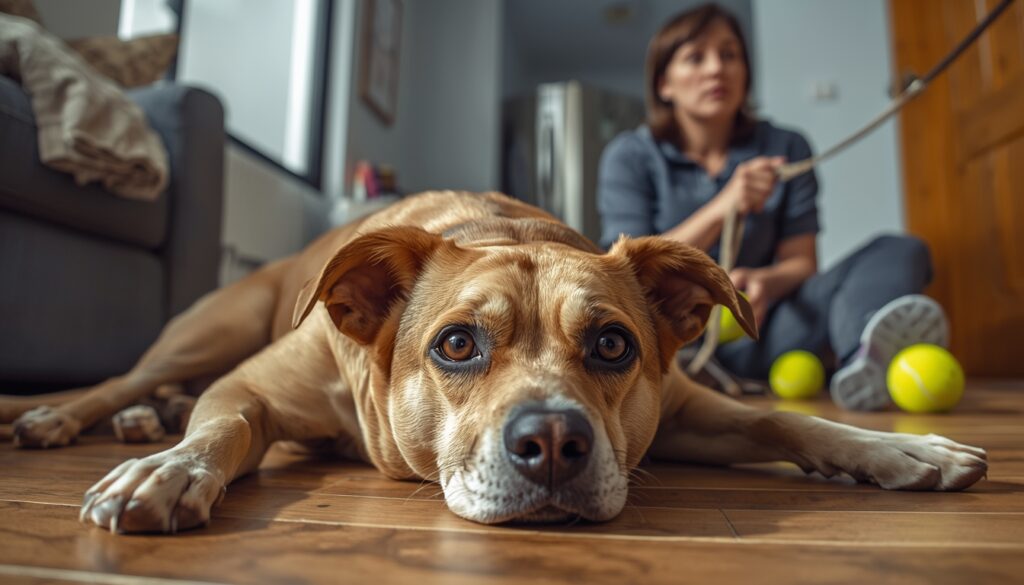
When a dog is anxious,
their body is already in alert mode.
Heart rate up.
Senses heightened.
Brain scanning for danger.
When I added intense exercise on top of that:
• Adrenaline increased
• Stress hormones stayed high
• Recovery took longer
I wasn’t calming him.
I was revving an already stressed system.
The moment it clicked for me
One evening, after a long, tiring day:
- long walk
- play session
- training
I expected calm.
Instead, my dog paced more than usual.
That’s when it hit me:
I was trying to exhaust anxiety out of him.
But anxiety doesn’t get tired.
Why exercise still matters (but differently)
This is important.
I didn’t stop exercising my dog.
I stopped using exercise as a cure for anxiety.
Here’s the difference I learned:
• Exercise is for physical health
• Calm is built through regulation
• Anxiety needs decompression, not depletion
Once I separated these ideas,
everything changed.
What I started doing instead
I didn’t flip everything overnight.
I adjusted slowly.
1. I stopped chasing “maximum tiredness”
I no longer aimed for:
“He should be wiped out.”
I aimed for:
“He should feel settled.”
Shorter walks.
Slower pace.
More sniffing, less marching.
2. I paid attention to recovery time
This was huge.
Earlier, after activity:
- I expected instant rest
Now, I allowed:
- quiet transition
- low stimulation
- space to come down
An anxious dog needs help coming back down,
not more stimulation.
3. I added calm after movement
Instead of:
Walk → play → done
I shifted to:
Walk → calm activity → rest
Things like:
• chewing
• quiet time together
• predictable routines
Movement opened the body.
Calm closed it.
The mistake I didn’t realize I was making
I thought:
“If he’s anxious, I should do more.”
But anxiety often needs:
“Do less, more intentionally.”
That shift changed how I looked at everything:
- evenings
- nights
- departures
- returns
What improvement actually looked like
Not dramatic.
But meaningful.
I noticed:
• Faster settling
• Less frantic energy
• Easier evenings
• Better sleep
Most importantly,
my dog stopped looking overwhelmed after activity.
When “tiring out” advice can still be useful
To be fair:
Some dogs do need more exercise.
But here’s the difference:
• Under-stimulated dog → bored behaviors
• Anxious dog → stress behaviors
They look similar.
They are not the same.
Treating anxiety like boredom
often backfires.
What I wish I had understood earlier
Exercise is a tool.
Not a solution.
Calm is not created by exhaustion.
It’s created by safety, predictability and recovery.
Once I stopped trying to run anxiety out of my dog
and started helping his nervous system slow down,
everything felt lighter.
For both of us.
A quieter way to look at anxious dogs
An anxious dog isn’t under-worked.
He’s over-alert.
And what helps over-alert systems
is not more pressure –
It’s permission to rest.