

 By
By (The changes that made things easier over time)
For a long time,
I thought helping my dog meant doing more.
More walks.
More routines.
More effort.
But when I finally took separation anxiety seriously,
the biggest changes weren’t about doing more.
They were about doing things differently.
At that stage, I didn’t even fully understand what separation anxiety really was.
I stopped waiting for anxiety to “show up”
This was the first real shift.
Earlier, I reacted after anxiety appeared.
Crying started → I responded.
Pacing began → I tried to calm him.
Destruction happened → I worried.
Everything was reactive.
When I took anxiety seriously,
I stopped waiting for visible signs.
I started supporting my dog before stress peaked.
That alone changed the intensity.
Looking back, many early signs were already there – I just didn’t recognize them.
I accepted that calm doesn’t return instantly
I realized that coming back home didn’t automatically mean my dog felt safe again.
This was hard to understand.
I expected my dog to relax the moment I came back home.
But anxiety doesn’t work on logic.
It works on nervous-system memory.
Even when I was present,
his body stayed alert.
Once I accepted that recovery takes time,
I stopped pushing him to “be normal” again.
Pressure reduced.
And with it, anxiety softened.
I focused on predictability, not reassurance
I used to reassure a lot.
Soft voice.
Petting.
Constant attention.
Sometimes it helped.
Sometimes it made things worse.
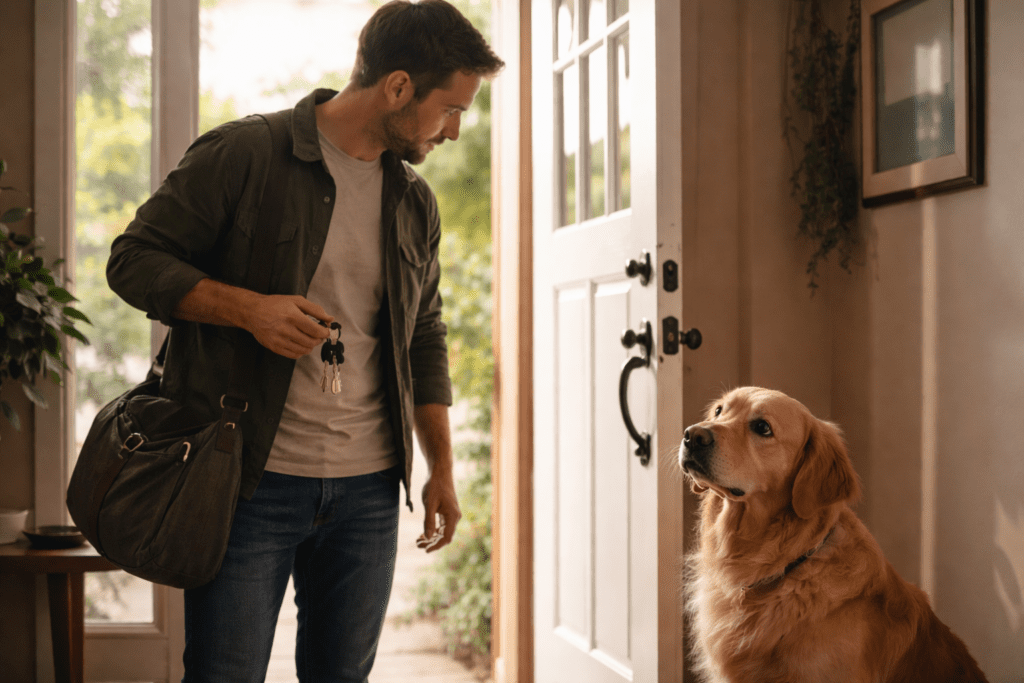
What helped more was predictability.
Same departure signals.
Same return energy.
Same daily rhythm.
Predictability told his nervous system:
“This isn’t dangerous. This is familiar.”
That message mattered more than comfort.
I changed my own emotional energy
This was uncomfortable to admit.
My dog wasn’t only reacting to separation.
He was reacting to my tension around separation.
I worried before leaving.
I felt guilty while leaving.
I rushed when returning.
Dogs feel that.
When I became calmer about leaving and coming back,
his reactions slowly followed.
Not immediately.
But noticeably.
I stopped confusing independence with isolation
At one point, I tried creating distance too fast.
Less attention.
More “ignore him so he learns.”
That backfired.
Taking anxiety seriously didn’t mean pushing independence.
It meant building tolerance gently.
Short separations.
Neutral returns.
No emotional extremes.
Confidence grew slowly –
but it grew in the right direction.
I paid attention to the whole day, not just departures
This was a major realization.
Separation anxiety doesn’t live only at the door.
It lives in:
• How the day flows
• How evenings slow down
• How nights settle
Once I supported calmer days and smoother evenings,
departures became less intense on their own.
Anxiety isn’t a moment.
It’s a pattern.
I stopped treating setbacks as failure
Some days were better.
Some days weren’t.
Earlier, bad days discouraged me.
Now, I expected them.
An anxious nervous system doesn’t heal linearly.
Progress looked like:
• Faster recovery
• Less intensity
• Shorter anxious periods
Not perfection.
Once I stopped demanding perfect calm,
real calm started appearing.
What improvement actually looked like
It wasn’t dramatic.
But it was real.
• Less monitoring
• Fewer panic reactions
• Easier evenings
• More relaxed body language
Most importantly,
my dog started trusting that separation didn’t mean danger.
That trust took time.
But once it started forming,
everything else became easier.
This wasn’t about a single technique
That’s important to say.
What helped wasn’t one trick.
Or one routine.
Or one solution.
It was a shift in how I understood anxiety.
I stopped fighting it.
I stopped rushing it.
I started supporting it.
And that changed the relationship completely.
What became clear over time
Separation anxiety doesn’t need to be “fixed.” (Separation Anxiety Signs)
It needs to be taken seriously.
When I did that,
I stopped reacting to symptoms
and started supporting the system underneath.
That didn’t erase anxiety overnight.
But it stopped it from controlling our lives.
And that was the moment
things truly began to change.
