


 By
By (What I didn’t realize it was connected to)
When my dog first destroyed something,
I didn’t think of anxiety.
I thought of boredom.
Lack of training.
Too much energy.
That’s what everyone says.
“He needs more exercise.”
“He needs toys.”
“He’s being naughty.”
I believed that too.
Until I noticed one detail
I couldn’t explain away. (“Anxiety Building Quietly”)
It only happened when I wasn’t home
This was the first crack in my assumption.
My dog didn’t destroy things randomly.
Not at night.
Not when I was around.
Not when the house was busy.
It happened when I left.
And only then.
The destruction wasn’t chaotic
It was targeted
This part stayed with me.
He didn’t chew everything.
He went for:
- Shoes near the door
- Cushions from the couch
- Things that smelled like me
This didn’t feel like boredom.
It felt emotional.
I realized he wasn’t “acting out”
He was coping
That shift changed everything.
My dog wasn’t trying to punish me.
He wasn’t being stubborn.
He was overwhelmed
and didn’t know where to put that feeling.
Destruction was his outlet.

Why destruction shows up in separation anxiety
I learned something important here.
When anxiety becomes too intense
and the dog can’t self-regulate anymore,
the body looks for release.
For some dogs, that looks like:
- Pacing
- Crying
- Shaking
For others, it turns into destruction.
Not because they want to destroy.
But because the tension has nowhere to go.
I noticed the destruction followed a pattern
Looking back, it didn’t come out of nowhere.
Before destruction, there was:
- Following me everywhere
- Panic before I left
- Crying when I walked out
- Trouble settling even after I returned
The destruction was not the start.
It was the next stage.
Why toys didn’t solve it
This surprised me.
I bought toys.
Chews.
Puzzle feeders.
They helped sometimes.
But they didn’t stop the destruction.
Because the problem wasn’t lack of stimulation.
It was emotional overload.
You can’t chew your way out of panic.
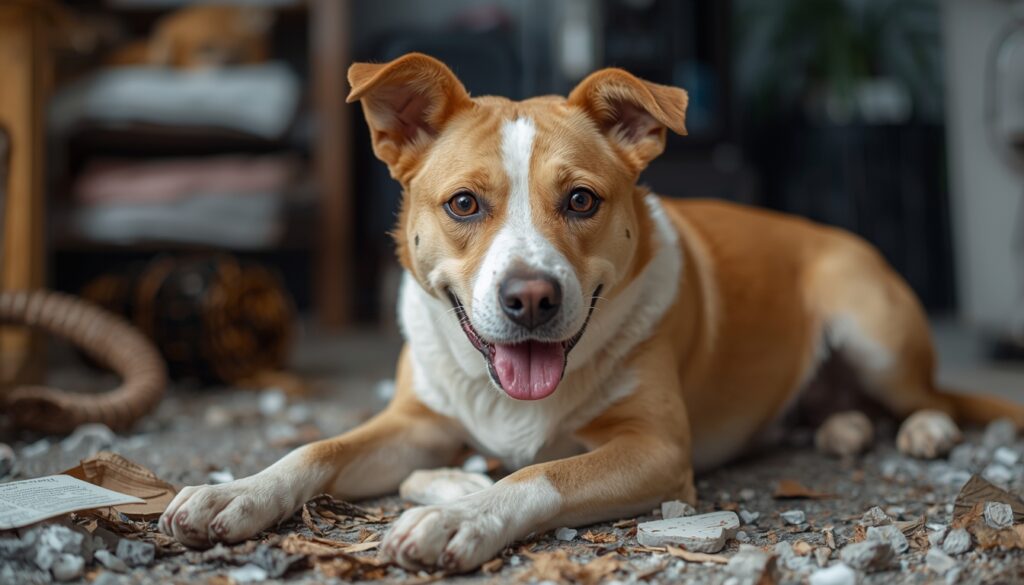
The timing mattered more than the damage
Another thing I misunderstood.
I focused on what he destroyed.
I should have focused on when.
The longer I was gone,
the worse it got.
That’s when I understood:
Time apart wasn’t neutral for him.
It was distressing.
And the distress built until it spilled over.
I also noticed what didn’t get destroyed
This part matters.
He didn’t destroy:
- Random furniture
- New objects
- Things without my scent
That told me everything.
This wasn’t about chewing.
It was about connection.
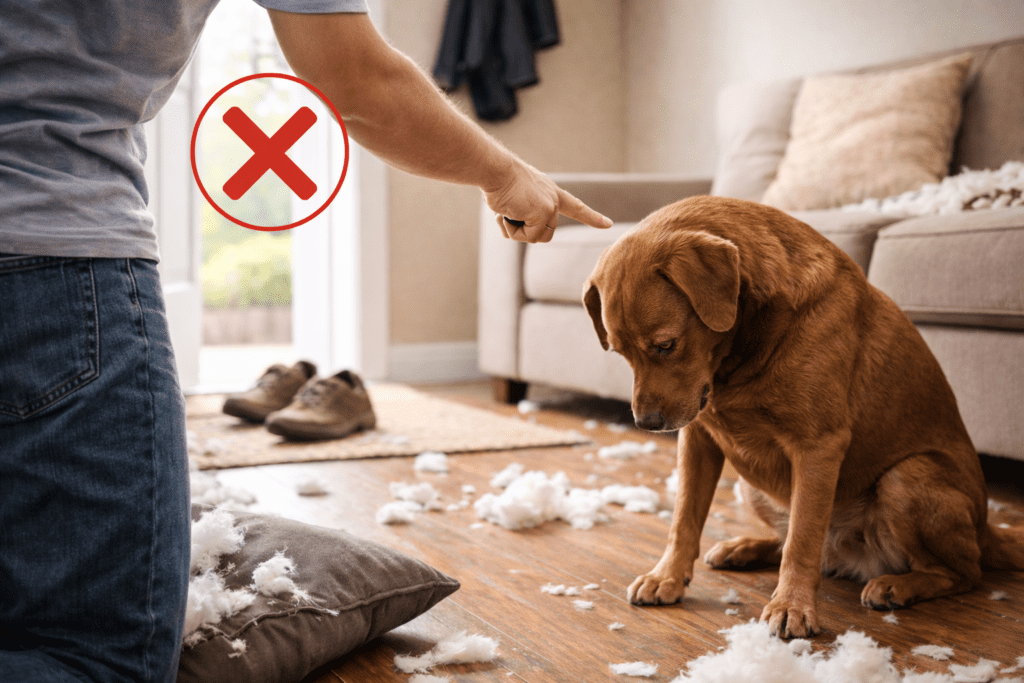
Punishment made it worse
I regret this part.
When I came home and saw the damage,
I got frustrated.
I raised my voice.
I showed him what he’d done.
His body language changed immediately.
Lower head.
Avoiding eye contact.
More tension.
The destruction didn’t stop.
The anxiety deepened.
Why destruction often appears “suddenly”
It feels sudden to us.
But for the dog,
it’s been building quietly.
Destruction usually appears when:
- Earlier signs were missed
- Anxiety stayed unaddressed
- The nervous system stayed activated too long
It’s not the beginning.
It’s the breaking point.
What changed once I understood the cause
I stopped treating destruction
as a behavior problem.
I started seeing it
as a stress signal.
That didn’t fix things overnight.
But it changed how I responded.
And that mattered.
Destruction isn’t disrespect
It’s desperation
This realization softened everything.
My dog wasn’t being “bad.”
He was trying to survive
a feeling that felt too big.
Once I stopped reacting to the mess
and started listening to the message,
the picture became clearer.
Looking back
If I could go back,
I wouldn’t ask:
“Why is he destroying things?”
I’d ask:
“What is he trying to release?”
Because destruction isn’t the problem.
It’s the evidence
that something inside couldn’t settle anymore.
And when you see it that way,
your response changes.
Not instantly.
But deeply.
